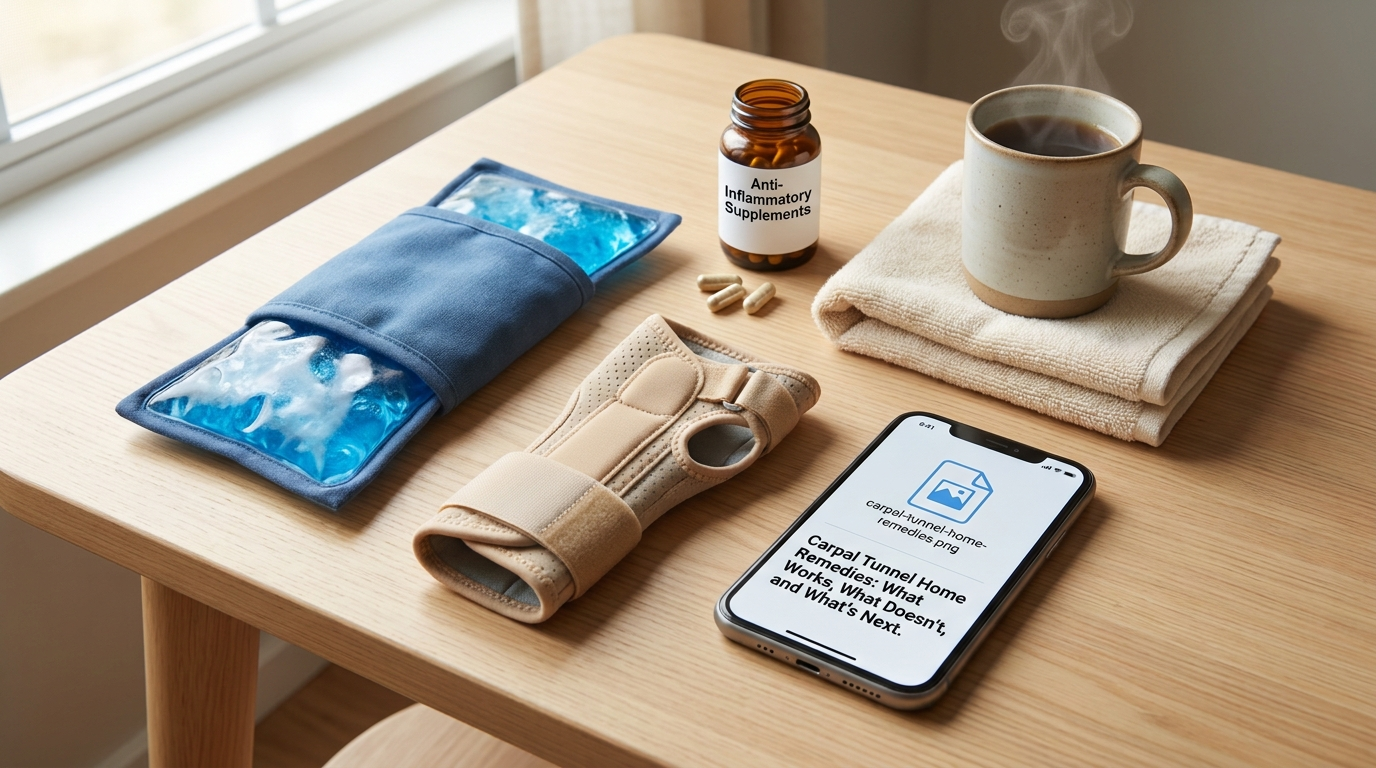
Carpal Tunnel Home Remedies: What Works, What Doesn't, and What's Next
The internet is full of carpal tunnel home remedies, ranging from well-studied to wishful thinking. Some of them genuinely help. Some do nothing. And one category — the most effective one — isn't usually classified as a "home remedy" at all, even though it's something you do at home, every day, without a doctor.
This guide rates every common home remedy by evidence quality and practical effectiveness. No filler, no hype — just what works and why.
Evidence Rating System
For each remedy, I've assigned a rating:
Strong evidence — Supported by randomized controlled trials or systematic reviews. Recommended by medical organizations.
Moderate evidence — Some clinical studies showing benefit, but limited in size or quality. Reasonable to try.
Weak evidence — Mostly anecdotal or theoretical. Low risk, low expected benefit.
No evidence — No credible studies supporting benefit for carpal tunnel specifically.
What Works
Night Splinting — Strong Evidence
A rigid wrist splint worn during sleep holds your wrist in a neutral position, preventing the flexion that compresses the carpal tunnel while you sleep.
Why it works: Nighttime wrist flexion is one of the primary aggravating factors for carpal tunnel. Preventing it for 6-8 hours per night dramatically reduces cumulative nerve compression. Multiple randomized controlled trials show 60-80% symptom improvement in mild to moderate cases.
How to do it right: Choose a splint with a rigid palmar stay that holds the wrist at 0-5 degrees of extension. Wear it every night for at least 4-6 weeks. Soft or flexible braces don't provide sufficient immobilization.
Verdict: This should be the first thing you try. Inexpensive, low risk, strong evidence.
Nerve Gliding and Tendon Gliding Exercises — Strong Evidence
Specific exercise sequences that mobilize the median nerve and flex the tendons through their full range of motion within the carpal tunnel.
Why it works: The median nerve can develop adhesions where it sticks to surrounding tissue. Nerve gliding exercises restore normal nerve mobility. Tendon gliding maintains tendon excursion and temporarily increases tunnel space.
How to do it right: Median nerve glide through six positions (fist → straight fingers → wrist extension → thumb extension → supination → gentle stretch). Tendon glide through five positions (straight → hook → fist → tabletop → straight fist). 5-10 minutes daily, 2-3 times per day.
Verdict: Second-most important home remedy. Free, evidence-backed, and most effective when done consistently.
Reducing Repetitive Motion Volume — Strong Evidence (for the Mechanism, Emerging for the Technology)
The most effective home remedy isn't a remedy at all — it's eliminating the cause.
Every other home remedy on this list operates on the recovery side of the equation: reducing inflammation, maintaining nerve mobility, preventing nighttime compression. Reducing repetitive motion volume operates on the damage side — producing less tendon swelling in the first place.
How to do it at home: Replace the navigational portion of your daily computer interactions (app switching, scrolling, clicking, window management, browser navigation) with voice commands. This typically reduces total daily keyboard and mouse interactions by 40-60%.
Neo by Jam handles this with voice commands processed in under 100 milliseconds, combined with eye tracking for spatial targeting. Push-to-talk activation, 100% local processing, over 95% command accuracy.
Why this belongs in a home remedies guide: It's something you implement at home (or wherever you work). It doesn't require a doctor. It addresses the root cause rather than managing symptoms. And it makes every other remedy on this list more effective by reducing the damage your recovery interventions are fighting against.
Verdict: Highest-impact change available. Not traditionally categorized as a "home remedy," but it is one.
Ice Application — Moderate Evidence
Applying ice to the wrist for 15-20 minutes, wrapped in a thin cloth to prevent skin damage.
Why it works: Cold reduces acute inflammation and can temporarily numb pain. Particularly helpful after a high-strain activity session.
Limitations: Temporary relief only. Does not address the underlying cause of inflammation. Prolonged or repeated icing can restrict the blood flow needed for tissue repair.
How to do it right: 15-20 minutes on, at least 40 minutes off. Use during flare-ups, not as a continuous treatment. Ice is most beneficial immediately after a high-strain work session.
Verdict: Useful for acute symptom management. Not a long-term solution.
Wrist Flexor and Extensor Stretches — Moderate Evidence
Stretching the muscles and tendons of the forearm to reduce resting tension.
Why it works: Tight forearm muscles increase the baseline tension on the flexor tendons, which pass through the carpal tunnel. Stretching reduces this resting tension, potentially increasing the space available for the median nerve.
How to do it right: Extend your arm, gently pull fingers back for wrist flexors (palm up) and push fingers down for extensors (palm down). Hold 20-30 seconds, repeat 3 times each arm. Do throughout the day, especially before and after typing sessions.
Verdict: Low risk, easy to do, reasonable evidence. Best combined with nerve and tendon glides.
What Might Help
Heat Application — Moderate Evidence (for Stiffness, Not Inflammation)
Warm compresses or warm water soaks can improve blood flow and reduce stiffness.
Important distinction: Ice reduces acute inflammation. Heat improves circulation and reduces stiffness. If your carpal tunnel is actively inflamed (swollen, hot to touch, acute flare-up), ice is better. If your wrists feel stiff and tight (morning stiffness, chronic low-grade discomfort), warmth may help more.
How to do it right: Warm (not hot) water soak for 10-15 minutes, or a warm compress. Some people find alternating warm and cool water (contrast therapy) helpful for stimulating circulation.
Verdict: May help with stiffness and circulation. Not a primary treatment.
Anti-Inflammatory Diet — Weak to Moderate Evidence
Eating foods rich in omega-3 fatty acids, antioxidants, and anti-inflammatory compounds while reducing processed foods, refined sugars, and excess alcohol.
Why it might work: Systemic inflammation contributes to tendon swelling. An anti-inflammatory diet may reduce the baseline inflammatory state that narrows the carpal tunnel.
Realistic expectation: Dietary changes alone are unlikely to resolve carpal tunnel syndrome. But reducing systemic inflammation may provide a modest complementary benefit alongside more targeted interventions.
Verdict: Good for general health regardless. Minor expected benefit for carpal tunnel specifically.
Compression Gloves — Weak Evidence
Lightweight gloves that apply gentle, even pressure across the hand and wrist.
Why they might work: Some users report reduced swelling, improved proprioception (awareness of hand position), and warmth. The compression may mildly reduce fluid accumulation in the hand.
Limitations: The evidence is largely anecdotal. Controlled studies have not demonstrated significant benefit beyond placebo for carpal tunnel specifically.
Verdict: Low cost, low risk, low expected benefit. Worth trying if other interventions are already in place.
Yoga — Weak to Moderate Evidence
Regular yoga practice, particularly poses that open the chest, extend the wrists, and stretch the shoulders and forearms.
Why it might work: A small University of Pennsylvania study found that carpal tunnel patients who practiced yoga showed greater grip strength improvement and pain reduction than a control group using wrist splints only. The mechanism likely involves improved upper body flexibility, circulation, and postural patterns.
Verdict: Good for overall health. May provide complementary benefit. Not sufficient as a standalone treatment.
What Doesn't Work
Essential Oils — No Evidence
No controlled studies demonstrate that any essential oil (peppermint, lavender, eucalyptus, or others) treats carpal tunnel syndrome. Some oils may provide a mild cooling or warming sensation, but this is a skin-level effect that doesn't reach the carpal tunnel.
Magnets and Copper Bracelets — No Evidence
Magnetic therapy and copper bracelets have been studied for various musculoskeletal conditions. No credible evidence supports their effectiveness for carpal tunnel or any other specific condition.
"Carpal Tunnel Creams" — No Evidence
Various topical creams marketed for carpal tunnel are available online. None have demonstrated the ability to meaningfully reduce median nerve compression through topical application. Some contain menthol or capsaicin, which produce a sensation of warmth or cooling but don't address the structural cause.
Ultrasound Therapy (Home Devices) — Weak Evidence
Consumer-grade therapeutic ultrasound devices are marketed for carpal tunnel. While professional therapeutic ultrasound has some evidence for reducing soft tissue inflammation, consumer devices typically lack the intensity and precision of clinical equipment. The evidence for home use is insufficient.
The Home Remedy Stack
In order of expected impact:
- Night splint — Every night. Immediate intervention.
- Repetitive motion reduction — Replace navigational computer interactions with voice control. Highest long-term impact.
- Nerve and tendon gliding exercises — 5-10 minutes, 2-3 times daily.
- Wrist stretches — Throughout the day, especially before and after typing.
- Ice — After high-strain sessions for acute inflammation management.
- Warmth — For morning stiffness and chronic tightness.
- Anti-inflammatory diet — Complementary support for overall inflammation reduction.
The remedies that work all share a common thread: they either prevent mechanical compression of the nerve (splinting, strain reduction) or maintain the health of the structures within the carpal tunnel (exercises, stretches). The ones that don't work are the ones that try to treat a mechanical problem with a non-mechanical intervention.
I tried every home remedy on this list. The night splint and exercises helped. But the change that actually resolved my carpal tunnel was reducing the repetitive strain causing it — through Neo's voice and gaze control for navigational computer interactions. The best home remedy is the one that addresses the cause, not just the symptoms. Start your free trial.