Carpal Tunnel Massage Techniques: Self-Massage Guide for Instant Relief
Massage won't cure carpal tunnel syndrome. Let's get that out of the way upfront. What massage can do — and do well — is reduce the muscle tension, improve the circulation, and temporarily relieve the pain that makes carpal tunnel feel unbearable at the end of a long work day.
Think of massage as a pressure release valve. It doesn't fix the plumbing, but it keeps things from blowing up while you address the underlying issue.
Here's a practical self-massage guide you can do at your desk, no tools required.
Why Massage Helps Carpal Tunnel Symptoms
The carpal tunnel is compressed by swollen flexor tendons. Those tendons are controlled by muscles in your forearm. When those muscles are tight, they increase the resting tension on the tendons, which increases the pressure within the carpal tunnel.
Massage addresses this by:
Releasing forearm muscle tension. Tight forearm flexors and extensors maintain elevated tendon tension even when you're not actively typing. Loosening these muscles reduces the baseline pull on the tendons.
Improving local circulation. Increased blood flow to the forearm and hand supports tissue recovery and helps clear inflammatory byproducts.
Reducing trigger points. Myofascial trigger points — tight knots within muscle fibers — can refer pain into the hand and wrist, mimicking or amplifying carpal tunnel symptoms. Releasing these points can reduce overall pain levels.
Temporary nerve decompression. By reducing muscle and tissue tension around the wrist, massage may temporarily increase the space available within the carpal tunnel.
Self-Massage Techniques
Technique 1: Forearm Flexor Release
These are the muscles on the underside of your forearm — the ones that control your finger and wrist flexion. They're the primary source of the tendon tension that compresses the carpal tunnel.
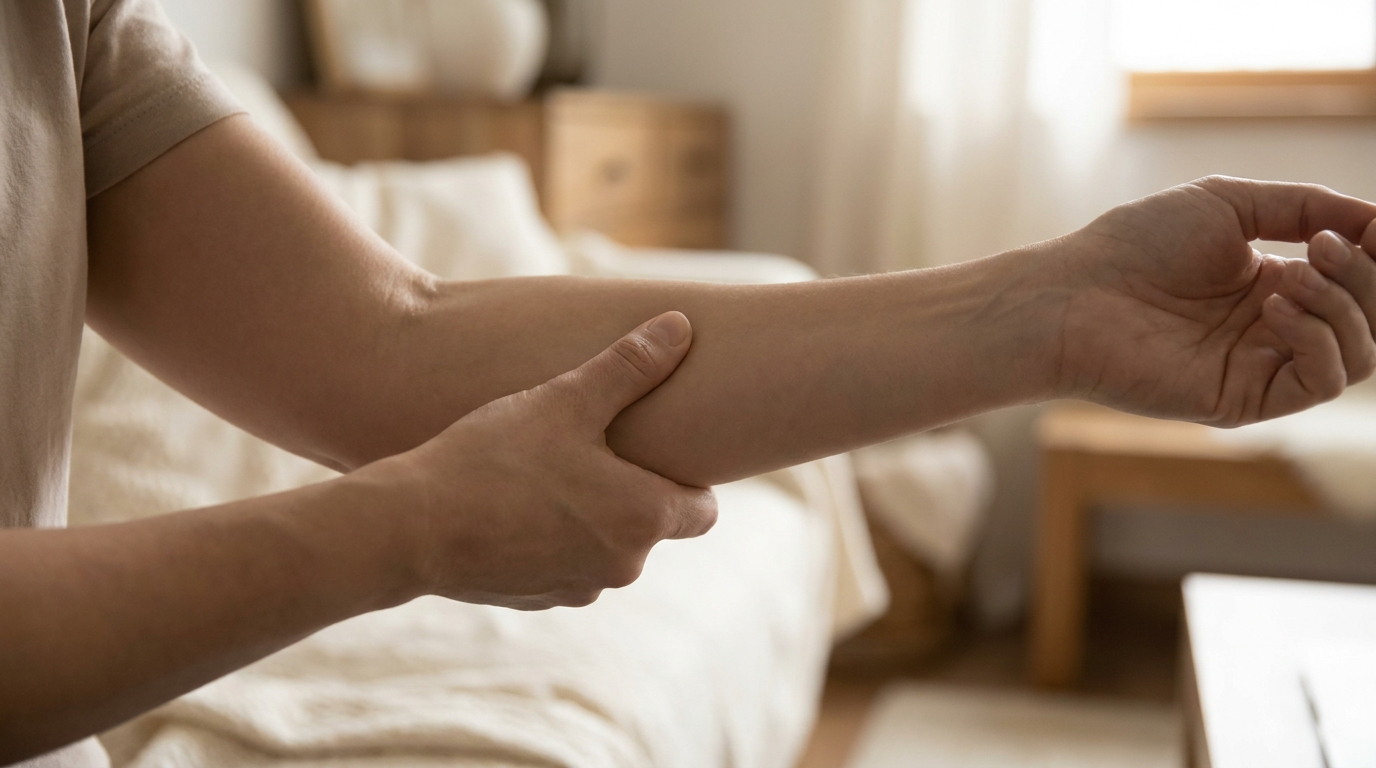
Position: Rest your forearm on a desk or your thigh, palm facing up.
Method: Using the thumb of your opposite hand, apply firm pressure to the fleshy part of your inner forearm, just below the elbow. Slowly slide your thumb from the elbow toward the wrist, maintaining steady pressure. When you find a tender spot, pause and hold pressure for 10-15 seconds, then continue.
Coverage: Work the entire inner forearm from elbow to wrist in 3-4 parallel lines (inner edge, center, outer edge of the muscle belly).
Duration: 2-3 minutes per arm.
Key areas: Pay special attention to the area 2-3 inches below the elbow crease — this is where the flexor muscles are thickest and most prone to tightness.
Technique 2: Forearm Extensor Release
The muscles on the top of your forearm (the extensors) work as counterbalances to the flexors. When they're tight, they can create compensatory tension patterns that worsen carpal tunnel symptoms.
Position: Rest your forearm on a surface, palm facing down.
Method: Using the thumb of your opposite hand, apply firm pressure to the top of your forearm. Work from the elbow toward the wrist in slow, deliberate strokes.
Duration: 1-2 minutes per arm.
Technique 3: Wrist Mobilization
Gentle mobilization of the wrist bones can reduce stiffness and improve the movement quality of the carpal tunnel structures.
Method: Hold your wrist with your opposite hand, thumb on the palm side, fingers wrapped around the back. Apply gentle traction (a light pull along the length of the forearm) while slowly moving the wrist through small circles. Keep the movements small and controlled — this isn't stretching, it's mobilization.
Duration: 30 seconds of circles in each direction, each wrist.
Technique 4: Thenar Eminence Massage
The thenar eminence is the fleshy pad at the base of your thumb. These muscles are heavily involved in grip and pinch actions, and they often develop tightness and trigger points in people with carpal tunnel.
Method: Using the thumb of your opposite hand, apply circular pressure across the entire pad of the thenar eminence. Work from the base near the wrist up toward the thumb. When you find tender spots, hold steady pressure for 10-15 seconds.
Duration: 1 minute per hand.
Technique 5: Finger Web Massage
The muscles between your metacarpals (the interossei) contribute to finger spreading and fine motor control. They fatigue quickly during sustained typing and mousing.
Method: Using the thumb and index finger of your opposite hand, squeeze and massage the web of tissue between each pair of fingers. Start between thumb and index finger, work across to between ring and pinky finger.
Duration: 30 seconds per hand.
Technique 6: Palm Cross-Fiber Work
The palmar fascia and the flexor retinaculum (the ligament forming the roof of the carpal tunnel) can be addressed through direct palm massage.
Method: Using the thumb of your opposite hand, apply moderate pressure in a cross-fiber direction (side to side, not up and down) across the center of your palm, focusing on the area between the base of your palm and the wrist crease.
Caution: Don't apply aggressive pressure directly over the carpal tunnel (the center of the wrist crease). Moderate pressure across the palm is different from digging into the carpal tunnel itself, which can irritate the already-compressed nerve.
Duration: 1 minute per hand.
The 5-Minute Desk Routine
Do this every 2-3 hours during a work day:
- Forearm flexor release — 1 minute each arm (2 minutes total)
- Thenar eminence massage — 30 seconds each hand (1 minute total)
- Wrist mobilization — 30 seconds each wrist (1 minute total)
- Finger web massage — 30 seconds each hand (1 minute total)
Total: 5 minutes. No tools required. Can be done at your desk without attracting attention.
Massage Tools Worth Trying
If self-massage with your thumb isn't reaching the right spots (or your opposite thumb is getting tired — a real problem when both hands are affected), these tools can help:
Lacrosse ball. Roll your forearm over a lacrosse ball on a desk surface. The ball provides concentrated pressure that your thumb can't sustain. Excellent for forearm flexor and extensor release.
Theracane or similar hook massager. The hook shape lets you apply pressure to your forearm without straining your opposite hand. Useful if both hands are symptomatic.
Electric hand massager. Several devices provide compression-based massage specifically designed for the hand and wrist. They automate the process and can be used while reading or watching content. Quality varies — look for adjustable pressure settings.
Foam roller. For broader forearm work, rolling your forearm over a foam roller on a desk provides general myofascial release. Less targeted than thumb pressure, but easier to sustain.
When to See a Professional
Self-massage is maintenance. If your carpal tunnel symptoms are moderate to severe, or if self-massage doesn't provide meaningful relief, a professional massage therapist experienced in treating RSI and carpal tunnel can apply techniques you can't effectively replicate on yourself:
Deep tissue work on the forearm flexors and extensors with sustained pressure that's difficult to self-apply.
Myofascial release of the fascial planes in the forearm and hand.
Active release technique (ART) — a specific protocol that combines practitioner pressure with client-performed movements to break up adhesions.
Neuromuscular therapy targeting trigger points that refer pain into the hand and wrist.
When searching for a therapist, look for one with specific experience in upper extremity RSI or carpal tunnel treatment. A general relaxation massage is pleasant but unlikely to address carpal tunnel mechanics specifically.
The Part That Determines Whether Massage Keeps Working
Massage provides relief because it reduces the muscle tension and tissue congestion that results from sustained repetitive wrist activity. The relief is real — but it's temporary, because the activity that created the tension hasn't changed.
If you massage your forearms for 5 minutes and then return to 4 hours of sustained keyboard and mouse use, the tension will rebuild to the same level by the end of the session. You'll need to massage again. And again. And again.
The way to make massage permanently effective — to massage your way to lasting improvement rather than temporary relief — is to reduce the repetitive activity that creates the tension.
When I started using voice control for the navigational portion of my computer work — the app switching, scrolling, clicking, and window management that doesn't require a keyboard — my daily forearm tension dropped noticeably. The massage sessions I'd been doing went from "emergency relief to get through the day" to "pleasant maintenance that keeps things loose." Neo by Jam handles these interactions through voice commands and eye tracking, processing commands locally in under 100 milliseconds.
Massage and strain reduction work synergistically. Massage releases the tension. Strain reduction prevents it from rebuilding to the same level. Together, they produce progressive improvement rather than a daily cycle of damage and relief.
Self-massage was my coping mechanism for months — 5 minutes of forearm work every couple of hours just to keep typing. It helped, but it was a treadmill. When I reduced my daily repetitive strain through Neo's voice control, the massage sessions went from survival to maintenance. The tension stopped rebuilding to the same level because the cause had been reduced. Start your free trial.