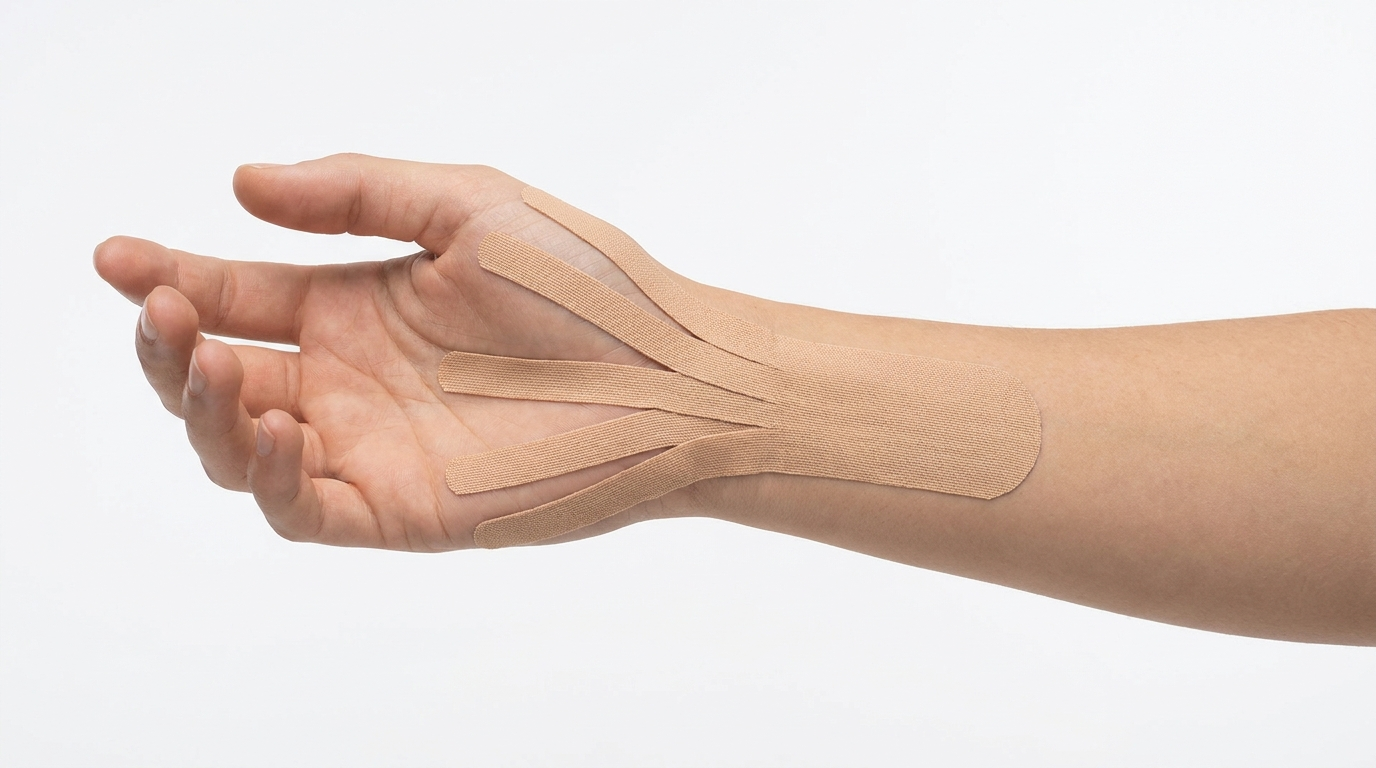
KT Tape for Carpal Tunnel: Does It Actually Help?
Kinesiology tape — the colorful elastic strips you see on athletes' shoulders and knees — has made its way into the carpal tunnel treatment conversation. With 6,600+ monthly searches for "KT tape carpal tunnel," there's clearly a lot of interest.
But does it actually work? The answer is nuanced: it might help some people with some symptoms, but the evidence is mixed and the mechanism is debated. Here's what we know, what we don't, and how to think about KT tape within a broader carpal tunnel management strategy.
What KT Tape Claims to Do
Kinesiology tape (Kinesio Tape, KT Tape, RockTape, and other brands) is an elastic adhesive tape applied in specific patterns over muscles and joints. For carpal tunnel, proponents claim it:
- Lifts the skin slightly, reducing pressure on the carpal tunnel
- Improves circulation and lymphatic drainage, reducing swelling
- Provides proprioceptive feedback (awareness of wrist position)
- Supports the wrist without restricting movement like a rigid brace
What the Research Says
Studies Showing Benefit
Several small studies have shown that kinesiology taping can reduce pain and improve function in carpal tunnel patients:
- A 2017 study in the Journal of Hand Therapy found that KT taping combined with nerve gliding exercises produced greater symptom improvement than exercises alone over a 4-week period.
- A 2019 systematic review found "limited but positive evidence" for kinesiology taping as a short-term pain management tool for carpal tunnel.
- Some studies show improved grip strength and reduced nighttime symptoms when taping is used in combination with other treatments.
Studies Showing No Significant Benefit
- A 2015 randomized controlled trial comparing KT taping to sham taping (tape applied without therapeutic tension) found no significant difference in outcomes — suggesting that any benefit may be placebo or simply due to the awareness of having something on your wrist.
- A 2020 review concluded that the evidence for KT taping in carpal tunnel was "insufficient to recommend as a standalone treatment."
- Several studies that showed short-term benefit found no sustained improvement after tape removal.
The Honest Assessment
The evidence for KT taping for carpal tunnel is:
- Better than nothing: Probably provides some short-term symptom relief for some people.
- Worse than night splinting: Night splints have substantially stronger evidence and directly address nighttime nerve compression.
- Not a standalone treatment: No credible study supports KT taping as the sole intervention for carpal tunnel.
- Potentially useful as a complement: May provide daytime symptom management alongside more evidence-based treatments.
How to Apply KT Tape for Carpal Tunnel
If you want to try KT taping, here's the most commonly used technique:
Basic Wrist Taping
Strip 1 — Anchor strip. Cut a strip about 6 inches long. Round the corners to prevent peeling. Apply the anchor end with no stretch to the back of your hand, just below your knuckles.
Strip 2 — Wrist support. Cut a strip about 8 inches long. Apply the center of the strip over the carpal tunnel (palm side of your wrist, at the crease) with 50-75% stretch. Lay the ends down with no stretch, wrapping around to the back of your wrist.
Strip 3 — Decompression strip. Cut a strip about 4 inches long. Apply the center directly over the carpal tunnel with 25-50% stretch. This strip aims to lift the skin and reduce external pressure on the tunnel.
Application Tips
- Apply to clean, dry skin. Shave hair if necessary for adhesion.
- Rub the tape after application to activate the adhesive.
- Apply 30-60 minutes before activity to allow the adhesive to set.
- KT tape can typically stay on for 2-5 days, including through showers.
- If you experience skin irritation, itching, or increased symptoms, remove the tape.
Where KT Tape Fits (and Doesn't Fit)
KT Tape Is Useful For:
Daytime symptom awareness. The tape provides a physical reminder to keep your wrist in a neutral position, which may be its most practical benefit — regardless of whether the mechanical claims are valid.
Activity-specific support. If you have a specific activity that triggers symptoms (a gym session, a gaming session, a long typing stint), taping beforehand may provide enough short-term support to get through the activity more comfortably.
Situations where rigid bracing isn't practical. You can't easily type with a rigid wrist brace. KT tape allows full range of motion while providing some level of support and awareness.
KT Tape Is Not Sufficient For:
Primary treatment. If KT tape is your only intervention, you're managing symptoms without addressing the cause. The tape doesn't reduce the repetitive motions that are inflaming your tendons.
Nighttime use. A rigid night splint is far more effective than KT tape for preventing the wrist flexion that compresses the carpal tunnel during sleep.
Moderate to severe carpal tunnel. The potential benefits of KT tape are too modest to meaningfully address moderate or severe nerve compression. These cases require stronger interventions.
The Bigger Picture: Symptoms vs. Causes
KT tape, at its best, is a symptom management tool. It may reduce pain and improve wrist awareness while you're wearing it. When you remove it, the benefit goes away — because the underlying cause hasn't changed.
The hierarchy of carpal tunnel interventions, ordered by what they address:
Symptom management: KT tape, ice, NSAIDs, compression gloves. These make you feel better temporarily without changing the disease process.
Damage reduction: Night splints (prevent nighttime compression), ergonomic equipment (reduce strain per motion), exercises (maintain nerve and tendon health). These slow the progression.
Cause elimination: Reducing the volume of repetitive motion that's creating tendon inflammation in the first place. This addresses the root cause.
The most effective approach stacks all three levels. KT tape can be part of the symptom management layer. But if that's the only layer you're working on, your carpal tunnel is likely to continue progressing.
For cause elimination, voice control replaces the navigational portion of daily computer interactions — the app switching, scrolling, clicking, and window management that account for 40-60% of daily keyboard and mouse usage — with voice commands and eye tracking. Neo by Jam processes these commands in under 100 milliseconds with over 95% accuracy, running entirely on your local machine.
When you reduce the repetitive motion that's causing the tendon inflammation, the downstream symptoms improve — including the symptoms that KT tape was trying to manage. Several users have reported that KT tape went from "necessary to get through the day" to "optional" after they reduced their daily repetitive strain with voice control.
Should You Try KT Tape?
If you're already doing the fundamentals — night splinting, exercises, reducing repetitive strain — and you want additional daytime comfort, KT tape is a low-risk addition. It's inexpensive, non-invasive, and if it helps even modestly, that's a net positive.
If KT tape is your first and only intervention, your expectations should be low. It's treating the headache, not fixing the thing that's hitting you on the head.
KT tape was part of my carpal tunnel management for a while — it provided some daytime comfort. But the interventions that actually resolved my symptoms were night splinting, daily exercises, and reducing my repetitive strain through voice control. When I addressed the cause, the symptom management became optional. Try Neo free.